Written by
Nina Childers
Dry hair and damaged hair feel similar at first. Both can be rough, dull, and difficult to style. Both can frizz. Both can resist looking polished no matter what products you apply.
But they’re not the same thing, and treating them the same way leads to frustration, because the underlying problem is completely different.
Dry hair lacks moisture. Damaged hair has a structural problem that moisture alone cannot fix.
Here’s how to tell which one you’re dealing with, and what to actually do about each.
Book a Hair Health Consultation
 What Dry Hair Actually Means
Dryness in hair is about moisture levels. Hair becomes dry when it isn’t retaining enough water, or when the natural oils produced by the scalp aren’t traveling down the hair shaft efficiently.
Common causes of dry hair:
- washing too frequently
- heat styling without a protectant
- hard water with high mineral content
- seasonal changes, dry winter air or summer heat and sun
- using sulfate-heavy shampoos that strip natural oils
- not conditioning thoroughly or consistently enough
Signs that your hair is dry rather than damaged:
- hair feels rough or straw-like, but doesn’t break easily
- hair responds noticeably to moisture, a conditioning mask makes it feel better quickly
- frizz calms down with product applied
- the hair looks dull but holds its length and doesn’t snap at the mid-shaft
- hair feels immediately softer and more manageable after a deep conditioning treatment
The encouraging thing about dry hair: it responds well to moisture. A consistent conditioning routine, a weekly mask, and a switch to a sulfate-free shampoo can often make a significant difference within a few weeks.
 What Damaged Hair Actually Means
Damaged hair isn’t about moisture levels, it’s about structural integrity. Hair is made of protein (keratin) organized in a structure held together by chemical bonds. When those bonds are broken or the protein structure is compromised, the damage is internal. Moisture helps the hair feel better temporarily, but it doesn’t rebuild what’s been broken.
Common causes of damaged hair:
- chemical processes, especially bleaching, relaxers, or repeated overlapping color
- excessive heat styling without protection over time
- mechanical stress, rough brushing, tight elastics, friction from cotton pillowcases
- over-processing (too many chemical services in too short a period)
Signs that your hair is damaged rather than just dry:
- breakage, especially mid-shaft (not just at the ends)
- split ends that travel far up the hair shaft rather than staying at the tip
- hair that feels mushy, gummy, or overly elastic when wet
- hair that won’t hold a curl or style for more than a few minutes
- hair that looks dull even with leave-in products and gloss applied
- hair that feels rough and straw-like even after deep conditioning
 A Simple Way to Check: The Porosity Test
Porosity describes how easily the hair absorbs and releases moisture, and it’s one of the most useful things to understand about your hair’s current condition.
To check your hair’s porosity: take a few clean, dry strands of hair and place them in a glass of room-temperature water.
- Hair floats (low porosity): the cuticle is tightly closed. Products can sit on top rather than absorbing. Hair may resist moisture but is also more resistant to damage.
- Hair slowly sinks over a few minutes (normal porosity): the cuticle opens and closes normally. Hair accepts moisture well and holds color effectively.
- Hair sinks quickly (high porosity): the cuticle is lifted or compromised. Hair absorbs moisture rapidly but also loses it quickly. This is often associated with chemical processing or physical damage.
High porosity hair benefits significantly from protein treatments and products that help fill and seal the cuticle, and is a strong indicator that a conversation with your stylist about a treatment plan is worthwhile.
 What to Do About Dry Hair
Dry hair responds to consistency. A few adjustments that make a real difference:
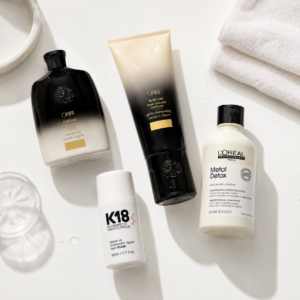
- Switch to a sulfate-free shampoo. Oribe Gold Lust shampoo and conditioner is a top recommendation, deeply nourishing, gentle, and excellent for maintaining softness and shine between appointments.
- Condition thoroughly after every wash. Don’t rush the conditioner. Leave it on for at least 3-5 minutes, concentrating on the mid-lengths and ends where dryness is most pronounced.
- Use a deep conditioning mask once a week. A weekly mask replenishes moisture that daily habits and environmental exposure pull out. Ask your stylist which formula suits your hair type.
- Address hard water. L’Oréal Professionnel Metal Detox removes the mineral buildup from hard water that blocks moisture from penetrating the hair shaft. For guests who notice their home water leaving hair feeling rough or dull, this is one of the most effective solutions.
- Wash less frequently. Most hair types do well with 2-3 washes per week. Dry shampoo at the roots between washes keeps hair feeling fresh without stripping moisture.
A professional in-salon hydrating mask treatment is also an excellent option for a fast, significant reset, particularly after summer, when hair has gone through months of heat and environmental stress.
 What to Do About Damaged Hair
Damaged hair requires a different approach, one focused on rebuilding structure, not just adding moisture.
Bond repair treatments
Bond repair treatments work at the molecular level to rebuild the chemical bonds that have been broken by bleach, heat, or chemical processing. These are among the most effective professional treatments for truly damaged hair. Ask your stylist about bond repair services and whether they’re appropriate for your current hair condition.
Protein treatments
Protein treatments reinforce the hair’s structural integrity by filling in gaps in the cuticle and cortex with hydrolyzed protein. They’re particularly beneficial for hair that feels gummy or elastic when wet, a clear sign of significant protein loss.
A strategic trim or cut
When split ends are traveling far up the hair shaft, removing the compromised length is sometimes the most practical and effective step. It prevents further damage from traveling, allows the remaining hair to behave better, and gives a fresh foundation to build from. Your stylist will advise on how much needs to come off to make a meaningful difference.
Reducing future damage
Rebuilding damaged hair requires reducing the sources of damage going forward:
- heat protectant before every styling session, every time
- gentler elastics (spiral elastics, no metal clasps)
- lower heat tool temperatures
- appropriate spacing between chemical services
- a silk or satin pillowcase to reduce overnight friction
When to See Your Stylist
If you’re not sure whether your hair is dry, damaged, or some combination of both, a conversation with your stylist is the most direct path to an answer.
They can assess your hair’s current condition, identify the likely causes, and recommend the right combination of in-salon treatments and home care. Guessing at home without knowing what you’re treating is the most common source of frustration, and it can sometimes make things worse.
Ready to restore your hair’s health?
Reserve your appointment at Ateliér Beauty in Chester Springs or Phoenixville. Our stylists will assess your hair’s current condition and put together a plan that addresses what it actually needs.


Show Comments